


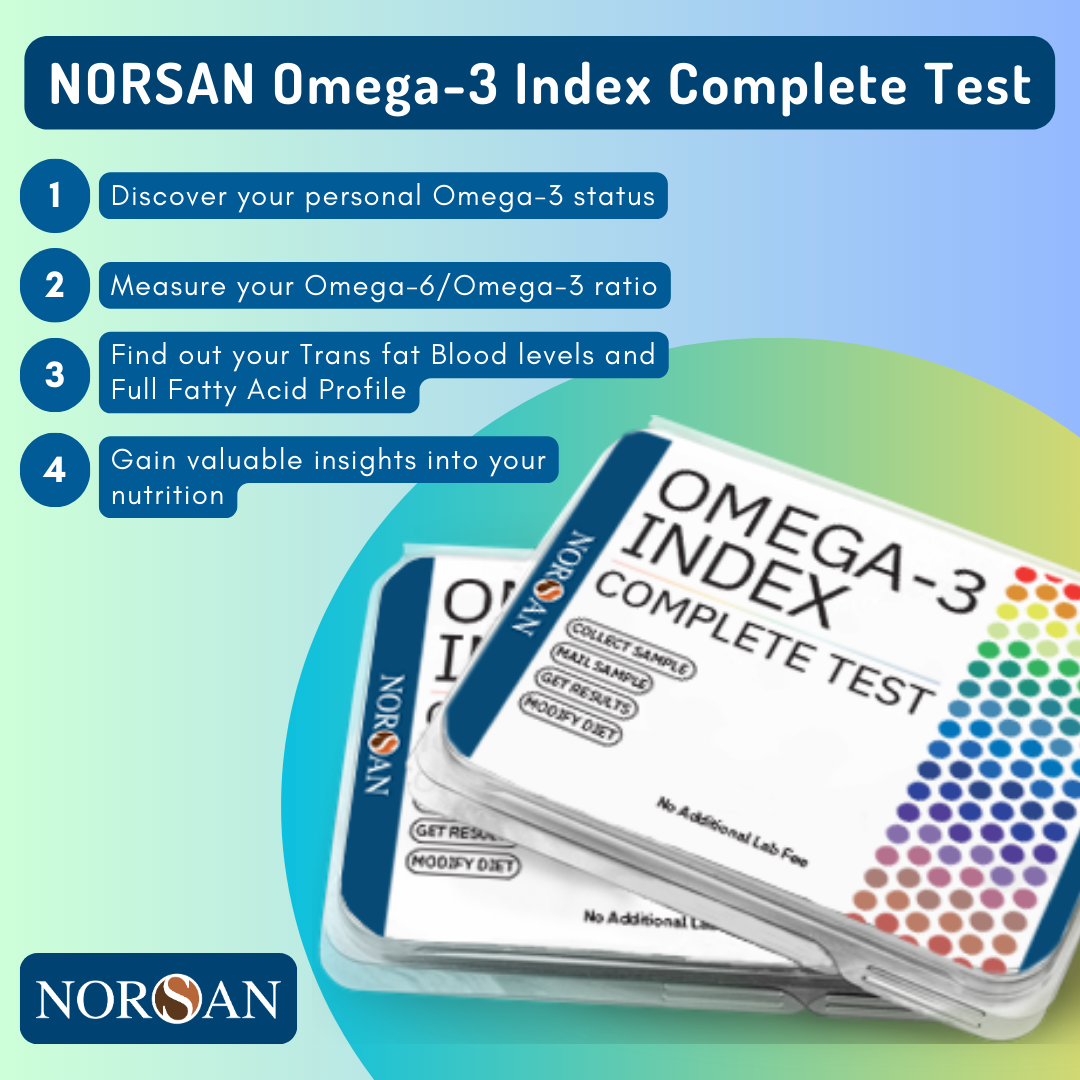
OMEGA-3 Index Complete Test
Discover your personal Omega-3 status with a simple at-home blood test. The NORSAN Omega-3 Test Kit Complete provides a detailed fatty acid profile (24 fatty acids), including your Omega-3 Index and Omega-6/Omega-3 ratio, analyzed by a certified laboratory.
Free US Shipping | 100% Money-Back Guarantee
We also recommend
OMEGA-3 Index Complete Test
Hvis du har noen spørsmål, er du alltid velkommen til å kontakte oss. Vi svarer så snart som mulig, innen 24 timer på hverdager.
-
Kundeservice
Vi setter stor pris på din tillit og er her for å hjelpe.
-
Gratis frakt
Du får gratis frakt på alle bestillinger.
-
FAQ
Har du et spørsmål? Besøk FAQ siden vår!
-
Kontakt oss
Vi vil gjerne høre fra deg. Send oss en melding!
Your health deserves clarity
With the NORSAN Omega-3 Test Kit Complete, you can easily measure your fatty acid balance and gain valuable insights into your nutrition. The test is simple, reliable, and performed at home with a small finger-prick blood sample.
What you get:
- A Test Kit with all necessary materials
- Easy instructions for collecting a small blood sample
- Prepaid envelope to send your sample to our certified lab
- A detailed report with your Omega-3 Index, Omega-6/Omega-3 ratio, and full fatty acid profile
- Practical recommendations to help improve your balance
Why it matters:
Most Americans consume too little Omega-3 and too much Omega-6. This imbalance can affect heart health, brain function, and inflammation levels. With this analysis, you receive a clear number you can track over time – empowering you to make informed dietary choices.*




Key Benefits
🧪 Scientific accuracy – lab-based analysis of your fatty acid profile
🏠 Convenience – collect your sample at home
📊 Personalized results – clear report with actionable insights
🔄 Track progress – repeat the test to monitor improvements
Usage
- Order your kit online
- Collect your blood sample at home (finger prick)
- Send it to our certified lab
- Receive your detailed report within 2–3 weeks
FAQ
What Does the Omega-3 Index Measure?
The Omega-3 Index is the proportion of long-chain omega-3s, eicosapentaenoic acid (EPA), and docosahexaenoic acid (DHA), of all fatty acids in your red blood cell membranes. It reflects the omega-3 status of your body over the last 4 months, similar to how hemoglobin A1C reflects long-term glucose blood levels.
If patients are taking omega-3 supplements, won’t their Omega-3 Index be above 8%?
No. There is no way to predict – for any given person – what his/her Omega-3 Index will be just by knowing how much fish they eat or how many capsules they take. Individual differences in metabolism, absorption, and genetics make it impossible to predict with certainty how a given person will respond to supplements.
How can I know if I am getting enough omega-3?
The only way is to directly measure the Omega-3 Index.
What is the target range for the Omega-3 Index?
The target Omega-3 Index is 8% and above, a level that current research indicates is associated with the lowest risk* for death from CHD. This is also a typical level in Japan, a country with one of the lowest rates of sudden cardiac death in the world. On the other hand, an Index of 4% or less (which is common in the US) indicates the highest risk*. At present, there is no reason to suggest that the target should be different for men vs. women, or for different age groups. Whether there is an upper limit of safety for the Index is not clear, but there is likely a value above which there is not likely to be any additional health benefit. Further research will help define this level.
*In this context, “risk” refers only to that associated with differing levels of omega-3 fatty acids. Risks associated with other factors such as cholesterol, blood pressure, diabetes, family history of CHD, smoking, or other cardiac conditions are completely independent of the Omega-3 Index. All risk factors – including the Omega-3 Index—should be addressed as part of any global risk reduction strategy.
What can I do to correct my Omega-3 Index?
Increase your intake of EPA+DHA. The amount you would need to take in order to raise your Omega-3 Index into the target range (>8%) depends in part on your starting level, but it cannot be predicted with certainty as described above. Nevertheless, if your Omega-3 Index is between 4% and 8%, we would recommend that you increase your current EPA+DHA intake by 0.5 -1 gram (500 – 1000 mg) per day. This can be accomplished in two ways: eating more oily fish and/or taking fish oil supplements. On the other hand, if it is less than 4%, our recommendation would be that you raise your intake by 1-3 g (1000 – 3000 mg) per day. Although this can be accomplished by eating more oily fish, fish oil supplements are usually necessary to achieve this level of EPA+DHA intake.
In our experience, to increase the Omega-3 Index by 4%, one would need to increase his/her intake by about 1 g of EPA+DHA per day for roughly 6 months. Alternatively, one could increase by 2 g/d and a 4% increase could be achieved more quickly. In other words, raising the Index is a function of both dose and time.
Why don’t the EPA and DHA values add up to the Omega-3 Index on my dried blood spot (DBS) report?
Whole blood and RBCs are different starting materials and the EPA+DHA content of each is different, but highly correlated. Based on multiple experiments, was derived a mathematical equation that converts the DBS EPA+DHA value into the corresponding RBC value (which is the Omega-3 Index). Therefore, the sum of EPA and DHA in the DBS report will usually be slightly different from the Omega-3 Index.
Can I use the NORSAN Omega-3 Index test in children?
Yes, the test works the same in children and adults. However, we typically recommend an Omega-3 Index of >6% as desirable for pediatric populations. Younger people tend to have lower Omega-3 Index levels and this study suggests that 6% is a therapeutic target for kids. Getting to 8% is still safe and desirable, but the target can be lower.